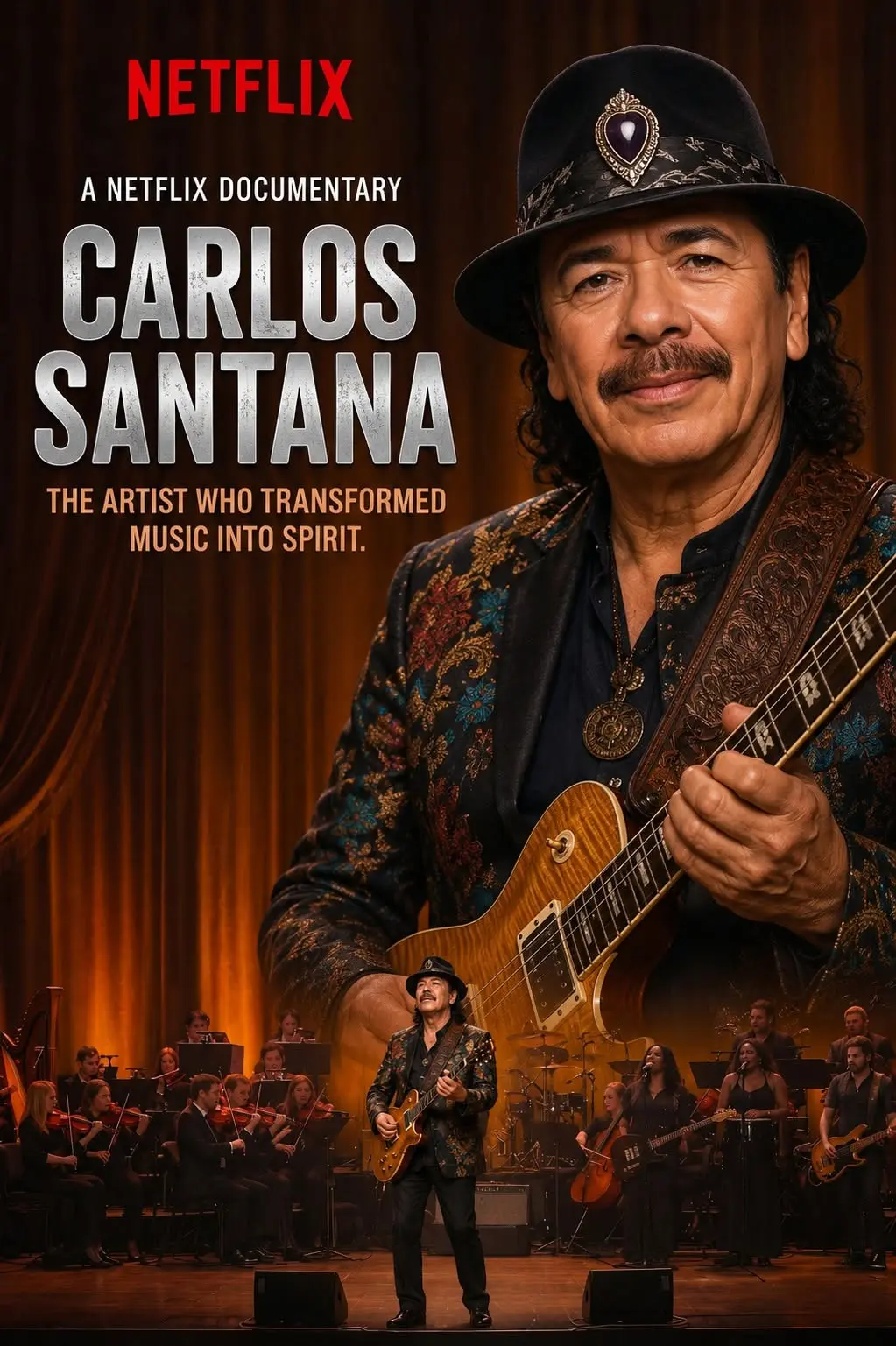
🚨🎸 “THE GUITAR STOPS… AND CARLOS FINALLY TELLS HIS STORY” — Emotional First Look at “THE SPIRIT OF SOUND” Promises to Reveal the Triumphs, Pain and Spiritual Journey Behind Carlos Santana’s Legendary Music ❤️🔥
For more than half a century, millions of people have recognized Carlos Santana before anyone even says his name.
One guitar note can be enough.
That warm sustain.
That unmistakable vibrato.
That combination of blues, rock and Latin rhythm that seems to carry emotion directly through the amplifier.
But behind one of the most recognizable sounds in modern music is a much larger human story — and that is the promise at the center of the documentary project described as Carlos Santana: THE SPIRIT OF SOUND.
Rather than treating Santana's career as a simple parade of hit songs, awards and sold-out concerts, the project is described as reaching toward something more intimate: the experiences, beliefs, struggles and relationships that shaped the musician behind the guitar.
And if that approach delivers on its promise, the most powerful moments may have very little to do with fame.
They may come when the music stops.

Santana's story begins far away from the giant arenas that eventually became familiar territory.
Born in Mexico, he was introduced to music at an early age. His journey eventually carried him to San Francisco, where he encountered a rapidly changing cultural and musical environment.
It was there that different influences began colliding.
Blues.
Rock.
Jazz.
Latin music.
Afro-Latin percussion.
Santana did not simply choose between those traditions.
He combined them.
That decision became the foundation of a sound that would eventually become almost impossible to imitate without immediately reminding listeners of him.
Then came Woodstock.
Santana's appearance at the legendary 1969 festival became one of the defining early images of his career.
The performance introduced the band to an enormous audience and helped demonstrate that the boundaries of rock music were much wider than many listeners had imagined.
But reducing Santana's story to Woodstock would miss almost everything that came afterward.
The harder achievement was not arriving.
It was enduring.
Music changed.
Fashion changed.
Radio changed.
The recording industry changed.
Entire genres moved in and out of the mainstream.
New generations of performers emerged.
Santana continued.
That longevity is one reason a documentary about his life has so much material to explore.

The public normally experiences a musician's life through highlights.
The breakthrough performance.
The successful album.
The award.
The standing ovation.
The comeback.
What audiences rarely see are the stretches between those moments.
The uncertainty.
The creative frustration.
The pressure of remaining relevant.
The personal consequences of spending decades inside a demanding industry.
A documentary becomes meaningful when it enters those spaces.
Santana's career offers a particularly fascinating opportunity because his public identity has never been based solely on musicianship.
Spirituality has long been intertwined with the way he discusses creativity.
For Santana, music has often appeared to represent something larger than entertainment — a language capable of crossing cultural and emotional boundaries.
That philosophy helps explain the title The Spirit of Sound.
The phrase suggests that the documentary would not simply ask how Santana plays.
It would ask why.
Why did this particular musician continue searching for new sounds?
Why did emotion become so central to his guitar tone?
Why did spiritual ideas remain connected to his artistic identity?
And what does a musician hear internally after spending decades performing for millions of people?
Those questions could make the difference between a conventional career retrospective and a genuinely intimate portrait.
There is also the extraordinary question of reinvention.
By the late 1990s, Santana had already lived through enough musical history to secure his legacy.
Then Supernatural arrived.
The album introduced Santana to another enormous generation of listeners and produced some of the most commercially successful music of his career.
“Smooth,” featuring Rob Thomas, became inseparable from that era.
For younger listeners, Santana suddenly did not feel like an artist from music history.
He felt current.
That accomplishment deserves attention because successful reinvention is extraordinarily difficult.
Established artists face a dilemma.
Change too little and audiences accuse them of repeating themselves.
Change too much and they risk losing the identity that made them distinctive.
Santana found another route.
He collaborated.
The guitar remained the anchor.
New voices and contemporary production could surround it, but when Santana entered the recording, listeners knew.
That recognizable musical identity became his bridge between generations.
Yet the emotional core of The Spirit of Sound, as described, would presumably exist away from the charts.
Rare backstage material can reveal things polished performances cannot.
A musician preparing alone.
A conversation moments before walking onto a stage.
The exhaustion after the encore.
The quiet space between public celebration and private reflection.
Those images can dismantle the mythology surrounding famous people.
The icon becomes human again.
That transformation is particularly compelling with Santana because his stage presence can feel almost mystical.
He often appears completely absorbed by the guitar, closing his eyes while notes stretch across the venue.
From the audience, those moments can seem effortless.
A documentary can reveal the discipline underneath them.
Great improvisation is not accidental.
Freedom on an instrument usually comes after years of repetition, failure, listening and refinement.
Behind every spontaneous phrase are thousands of hours nobody applauded.
That is where perseverance enters Santana's story.
His influence also cannot be separated from cultural identity.
Santana emerged during a period when the American musical mainstream did not always provide equal space for Latino artists and Latin musical traditions.
Yet Latin percussion was not presented as decoration in Santana's sound.
It was structural.
The rhythms helped define the music.
That gave millions of listeners exposure to musical ideas they might not otherwise have encountered through mainstream rock.
Over time, Santana became something difficult to categorize neatly.
Mexican-born.
American musical icon.
Rock guitarist.
Blues player.
Latin-rock pioneer.
Spiritual seeker.
Collaborator.
None of those descriptions alone is sufficient.
Perhaps that is why the music traveled so well across borders.
It was never confined to one box.
The strongest documentary would also resist turning the story into uninterrupted triumph.
Long careers contain difficult chapters.
They contain doubt.
Changing relationships.
Professional uncertainty.
Mistakes.
Moments when the next chapter is unclear.
Showing those experiences does not diminish a legacy.
It gives that legacy weight.
Success becomes more meaningful when audiences understand what had to be survived to reach it.
And ultimately, that may be the greatest opportunity presented by The Spirit of Sound.
Carlos Santana's achievements are already documented.
The records exist.
The performances exist.
The awards exist.
Woodstock exists.
Supernatural exists.
Millions already know the guitar.
What people may know less about is the man who carried that guitar through all those decades.
What frightened him.
What inspired him.
What kept him searching.
What spirituality meant when applause disappeared.
What he learned from failure.
What he still hopes music can accomplish.
Those are the questions capable of turning a music documentary into something more lasting.
Because eventually every concert ends.
The crowd leaves.
The stage goes dark.
The equipment is packed away.
Awards collect dust.
Charts move on.
What remains is impact.
A melody remembered decades later.
A young guitarist inspired to pick up an instrument.
A listener finding comfort in a song during a difficult night.
A rhythm connecting people who do not speak the same language.
That may ultimately be the real spirit of Santana's sound.
Not simply the notes he played.
But what those notes made people feel.
And after more than half a century of music, perhaps the most revealing chapter is not another performance at all.
Perhaps it is finally hearing the story behind the guitar.
Netflix has just unveiled the emotional first trailer for “Carlos Santana: THE SPIRIT OF SOUND,” and audiences around the world are already calling it one of the most powerful music documentaries of 2026. More than a story about fame and success, the film is an intimate and deeply inspiring portrait of the legendary guitarist whose music transcended generations, cultures, and borders.
The Artist. The Visionary. The Legacy. From his groundbreaking performance at Woodstock to becoming one of the most influential musicians in modern history, the documentary explores the passion, spirituality, and resilience that shaped Carlos Santana into a global icon. Beyond the spotlight and sold-out arenas, the film reveals the personal struggles, defining moments, and emotional journey behind the man whose guitar changed music forever.
More than just a music legend. Early critics are already praising the documentary as a breathtaking and deeply human masterpiece — a celebration of creativity, perseverance, and the healing power of music. Featuring rare backstage footage, never-before-seen recordings, and heartfelt reflections from fellow artists, friends, and Santana himself, the project promises to reveal a side of Carlos Santana the world has never fully seen before.
“He didn’t just play music for millions of people,” one producer shared. “Carlos Santana created emotion through every note. He became a symbol of passion, peace, spirituality, and artistic freedom. This film finally reveals the real Carlos — honest, soulful, and unforgettable.”