🎸 “THEN CARLOS SANTANA STOPPED PLAYING…” — Thousands Were Shouting, Security Was Moving In, and an Arena Seemed Seconds From Chaos. What Happened Next Was Almost Completely Silent.
The guitar stopped.
That was the moment everything changed.
Until then, the arena had been drowning in noise.
Not the exhilarating roar that normally rises before a legendary guitarist takes the stage. This was different. There was tension underneath it — something sharp, unpredictable and increasingly difficult to ignore.
People were shouting across sections.
Security personnel were moving through the crowd.
Small confrontations appeared to be spreading.
Boos collided with cheers until nobody seemed certain whether the audience was reacting to the music, to one another, or simply to the emotional pressure that had been building inside the building all evening.
Then Carlos Santana reportedly did something no one expected.
He did not play louder.
He did not attempt to overpower the crowd.
He did not demand attention.
He allowed the music to disappear.
And slowly, thousands of people began to notice the silence.

For a performer, silence can be terrifying.
Artists spend entire careers learning how to fill empty space.
A singer reaches for another note.
A drummer strikes another beat.
A guitarist bends another string.
Concerts are built around momentum.
Stopping can feel dangerous.
But sometimes silence becomes more powerful than another song.
Santana stood there with the instrument that had carried him across generations.
The same guitar language that had traveled from Mexico into San Francisco, through the psychedelic era, onto massive stages and into the memories of millions of listeners.
But he wasn't using it.
Not yet.
The crowd that had spent the previous minutes competing to be heard suddenly had nothing to compete against.
Without the music, every shout became exposed.
Every argument sounded louder.
Every angry voice seemed strangely isolated.
Then something began to change.
One section quieted.
Then another.
The transformation was not instantaneous.
It moved gradually through the building, almost like a wave traveling in reverse.
Instead of thousands of people rising together, thousands were settling.
Watching.
Waiting.
Listening for whatever Santana might do next.
The most dramatic response would have been a speech.
Instead, according to the story being told, Santana lowered his voice.
Almost a whisper.
That forced the audience to make a choice.
Continue shouting and miss him completely.
Or become quiet enough to hear.

There is something unusual about whispering inside an arena.
The entire architecture of the building is designed for amplification.
Huge speakers.
Towering lights.
Massive video screens.
Everything is supposed to make performers larger.
A whisper does the opposite.
It makes the audience come closer emotionally, even when the people in the highest seats are physically hundreds of feet away.
And Santana's public philosophy throughout his career has frequently emphasized ideas larger than music itself — love, spiritual connection and the possibility that sound can move people beyond division.
In a moment like this, those ideas become more than stage language.
They become a test.
Can music actually unite people who, only minutes earlier, appeared determined to fight?
Can one performer interrupt anger without adding more anger?
Can thousands of strangers remember, even temporarily, why they entered the same building in the first place?
The answer did not need to arrive through a long speech.
It could arrive through one note.
Santana eventually returned his hand to the guitar.
The arena waited.
Then came the sound.
Not an explosive riff.
Not a wall of distortion.
Just a controlled, singing note hanging in the air.
Santana's guitar tone has always been unusually suited to moments like that.
His playing can sound less like an instrument being attacked and more like a human voice stretching beyond language.
The sustain gives each note room to breathe.
The vibrato creates vulnerability.
The spaces between phrases matter.
On that imagined edge between chaos and calm, restraint became the entire point.
The crowd did not need more volume.
It needed somewhere to place its attention.
The guitar gave it one.
Then another note followed.
And another.
Gradually the band could return.
Percussion.
Bass.
Keys.
Drums.
But the atmosphere had changed.
The same thousands of people who had been fragmented into angry pockets were now listening to the same rhythm.
That is one of music's oldest mysteries.
A crowd can contain people who disagree about almost everything.
Politics.
Religion.
Culture.
Identity.
Money.
Generations.
Life.
But give them a song they all recognize and, for several minutes, their bodies can move to exactly the same beat.
They do not suddenly agree.
Their problems do not disappear.
Nothing outside the arena is magically solved.
But they share time.
Sometimes that is enough to interrupt hostility.
Carlos Santana's entire musical identity makes him a particularly fitting figure for such a story.
His music itself was built through combination rather than separation.
Rock guitar alongside Latin percussion.
Blues phrasing beside Afro-Latin rhythm.
Jazz improvisation mixed with pop accessibility.
Different traditions did not have to destroy one another.
They could occupy the same song.
That idea became central to the Santana sound.
It also offers a powerful metaphor for a divided audience.
Harmony does not require every instrument to play the same note.
In fact, music becomes richer precisely because they do not.
The bass has one role.
The drums another.
The guitar another.
Percussion fills different spaces.
Each sound remains distinct.
Yet together they create something none could produce alone.
A crowd can work the same way.
The people inside that arena did not need to become identical.
They only needed to stop treating difference as an invitation to hostility.
For a few minutes, the music offered another possibility.
That is why stories about moments like this spread so easily.
People want to believe music can still do something beyond entertainment.
They want to believe a song can reach places arguments cannot.
They want to believe one human being with an instrument can remind thousands of strangers that they share something.
And sometimes the strongest symbol is not the loudest one.
It is the moment before the note.
The silence.
Think about what silence requires from an audience.
Attention.
Restraint.
Patience.
Those were exactly the qualities the arena seemed to have lost.
By refusing to compete with the chaos, Santana transformed silence into a mirror.
People could suddenly hear themselves.
And perhaps they did not like what they heard.
The evening, according to the narrative, continued.
Music returned.
People who had been shouting were now singing.
Hands that might have been clenched earlier were raised toward the stage.
Security could breathe again.
The concert had not changed the world.
But for the duration of a song, perhaps it changed one room.
That distinction matters.
Stories about music sometimes become exaggerated because audiences want them to carry enormous meaning.
No guitarist can permanently heal social division with one performance.
No concert can eliminate the conflicts waiting outside the doors.
But art does not have to solve everything to matter.
Sometimes interrupting anger is enough.
Sometimes creating five peaceful minutes inside two chaotic hours is enough.
Sometimes reminding people that they can stand together without fighting is enough.
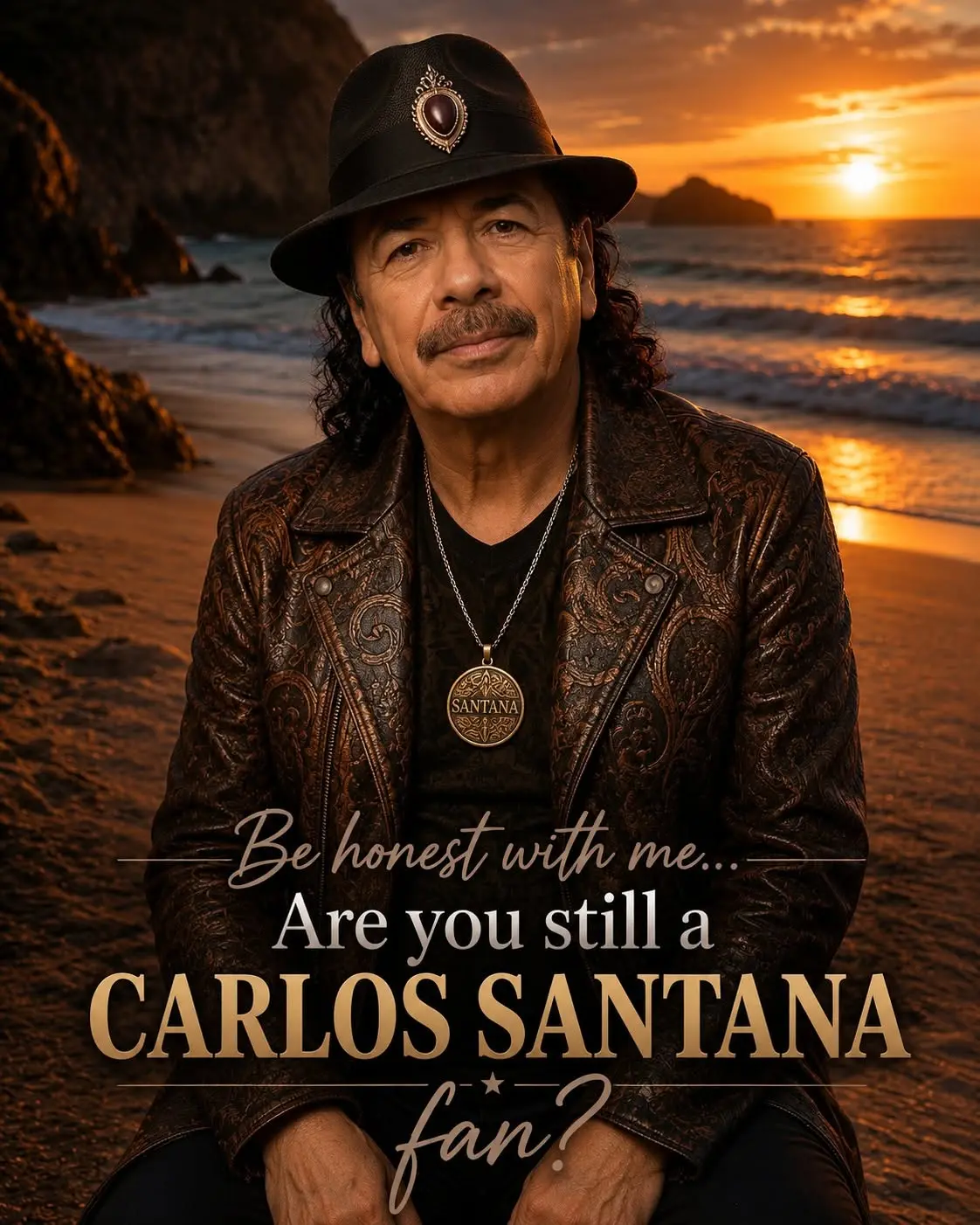
And that may be the deeper meaning behind the image of Santana holding his guitar before a divided crowd.
His greatest instrument in that moment was not necessarily the guitar.
It was restraint.
He understood something many performers forget.
When everyone is screaming, screaming louder rarely creates understanding.
Sometimes the only way to be heard is to become quieter.
That idea reaches far beyond an arena.
Modern life rewards volume.
Everyone is encouraged to react immediately.
To argue.
To post.
To choose sides.
To answer anger with greater anger.
Silence can feel like surrender.
But silence can also create space.
Space to listen.
Space to reconsider.
Space for another person to exist without becoming an enemy.
That is why the final image of this story feels so powerful.
Carlos Santana.
One guitar.
Thousands of people.
A room that moments earlier seemed to be tearing itself apart.
Then a whisper.
Then silence.
Then one note.
And suddenly, everyone was listening to the same thing.
Perhaps that is what music has always done at its best.
Not erase our differences.
Not pretend conflict does not exist.
But remind us, briefly, that beneath all the noise, human beings are still capable of listening together.
THE NIGHT THE WORLD TURNED QUIET: HOW CARLOS SANTANA HEALED A DIVIDED ARENA WITH A WHISPER
The Boiling Point
The air inside the arena wasn’t just thick; it was electric with a dangerous, volatile energy. It was a Saturday night that began with the promise of rock and roll salvation but had quickly spiraled into something unpredictable. Before the house lights even dimmed, a palpable division had ripped through the sold-out crowd. Perhaps it was the crushing weight of the outside world bleeding into the venue, or a series of escalating altercations in the packed general admission pit that set the hostile tone.
Whatever the catalyst, by the time the opening chords of the set echoed through the cavernous space, the audience was at war with itself. Boos mingled with cheers. Pockets of the arena were actively hostile, security flashing flashlights into the throngs as minor skirmishes broke out. The music, normally a unifying force, felt like it was bouncing off a brick wall of collective anxiety and anger. The spectacle was teetering on the edge of a riot.